How nature’s rhythms, ancient symbols and the stories the land holds can help us navigate life’s transitions.
Change is an inevitable part of life, yet learning to move through it isn’t always easy. How do we make peace with endings? How do we find our footing when familiar things begin to shift? And how might the wisdom carried through generations, in our stories, traditions and relationships with the natural world, help us navigate the changing seasons of our own lives?
As autumn settles in, I’ve been reflecting on these questions, drawn once again to the stories of the Brythonic lands and to my podcast conversation with Welsh artist, storyteller and ritualist Stella Marie Sheppard, in which we explored what it means to become a wisdom keeper. Her work has prompted me to look more closely at the wisdom that might be found in the folklore and rituals of my own native land.
Across cultures and generations, people have found ways to mark the turning of the seasons, honour the dead, celebrate new beginnings and make sense of the thresholds between one stage of life and another. Through stories, ceremonies and rituals, they have created ways to acknowledge change — not simply as something to endure, but as something to participate in, learn from and even welcome.
Perhaps there is wisdom here for us, too, in a world that often encourages us to keep moving, remain productive and resist the natural ebb and flow of life.
There are times of year when the changing world seems to invite us to pause and listen.
Late October into November is one of them.
Autumn: A Time of Change
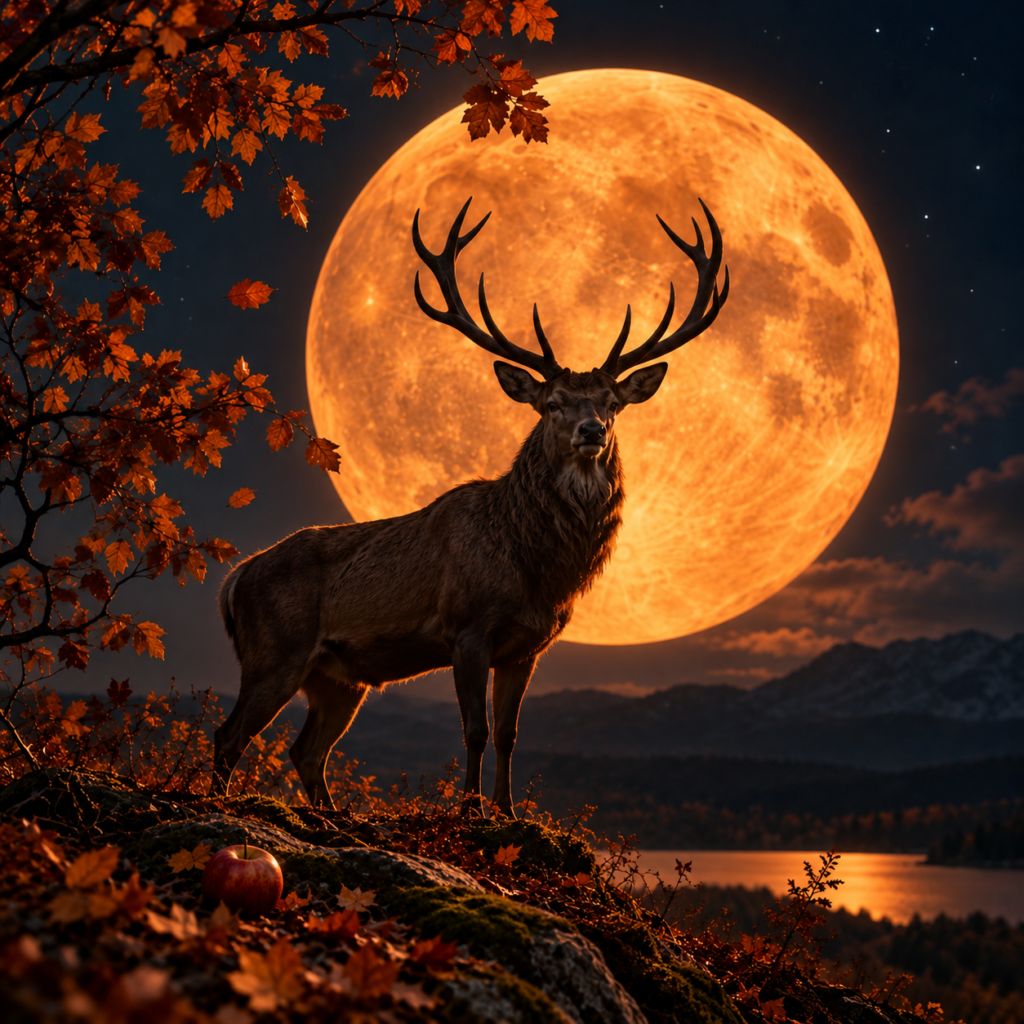
The evenings gather around us sooner. Frost settles over the fields, and colourful leaves loosen their hold on the trees, revealing the dark, branching skeletons beneath. Their bare limbs reach into the autumn sky, like the antlers of a stag emerging from the woods. The moon rises above the darkening landscape, and somewhere beyond the garden boundary a deer moves silently through the undergrowth in search of late autumn apples left on the tree.
In the traditions surrounding Samhain, the turning toward winter is associated with the Otherworld and the idea that the veil between worlds grows thin. It is a season that invites reflection on life and death, what we carry forward and what we must allow to fall away.
This autumn, I’ve been called to follow three symbols in particular: the moon, the stag and the apple. Their stories have led me to reflect on how we inhabit the changing seasons, how we find meaning in life’s mysteries, and how we might learn to recognise the sacred in the world around us.
The Moon: A Light We Share
Look up at the moon on a clear autumn night, and you are looking at something that has held our attention since the beginning of human history.
Across the world, people have watched its changing face, woven stories and rituals around its cycles and used its rhythms to mark time. Nearly as old as the world itself, mama moon has illuminated countless generations before us and may possibly be the most powerful symbol of the collective consciousness. She has witnessed the whole story. She is everyday magic.
There is historical evidence that the ancient Celtic peoples observed and measured the cycles of the moon. The Coligny Calendar, a bronze tablet dating to around the second century CE, records lunar months and adjustments to keep them aligned with the solar year. Discovered in what is now France, it offers a glimpse of how closely some communities in the ancient Celtic world followed the rhythms of the heavens.
And in honour of her meaningful presence, we have bestowed her with many names.
Late October brings the Hunter’s Moon, the traditional name for the full moon following the Harvest Moon, which means it can occasionally fall in early November. The name is associated with the season when the harvest was over and people prepared for the colder months ahead. The extra light after sunset could also help hunters see across fields as they prepared for winter.
The Moon Over My Native Land
In the place where I was born, the Appalachian mountains of Quebec, I find myself thinking about the many peoples who have watched the moon rise over this land — the Abenaki, English-American Empire Loyalists, the Celts and French-Canadians each carrying their own relationships with the seasons, waterways, forests and night sky.
The Abenaki name for October’s moon is Penibagos, the Leaf-Falling Moon. It draws our attention to the changing landscape, as leaves loosen their hold on the trees and the world turns toward winter. It is a reminder that seasonal time can be understood not only by looking at the sky, but also by noticing what is happening around us on the land.
My homeland in Quebec’s Eastern Townships is an agricultural region still largely shaped by the turning seasons. For Indigenous communities whose survival depended closely on the land and its rhythms, this seasonal shift could carry a more profound reality: the coming winter would not necessarily be survived by everyone. Knowing when to hunt, gather and prepare was a matter of life and death.
At this threshold between autumn and winter, the advancing season reminds us of our own mortality, and of why this time of year has long been associated with honouring the dead and drawing closer to the mysteries of the Otherworld.
Although the stories and interpretations of the peoples who have watched this moon might differ, what interests me is the invitation they offer: to look more closely at the place we inhabit and consider what it might teach us about sacred connection.
Perhaps the moon is one of the simplest places to begin. We can step outside, lift our eyes and remember that we are part of something much larger than our immediate concerns. In fact, one small act of attention can ripple out and connect us with all of existence.
The Stag: A Visitor at the Threshold
My connection with the stag began in a way I could never have planned.
During a guided visualization led by Stella inside her Radiant Brow Quest, I encountered an animal whose identity I couldn’t quite place. Was it an antelope? A unicorn? Something else entirely? I didn’t know, and I didn’t try to force an answer. “The answer will come when the time is right,” I thought. So, I stayed open to what might reveal itself.
About a week later, I was visiting a deer park in Yorkshire when I came face to face with a red deer stag.
There he was.
The encounter brought my visualization into focus. In that instance, I knew. I was left with a sense of sacred trust and a feeling that some experiences are better approached with curiosity than with an immediate need to explain them.
I wrote this poem afterwards — a form of creative capture that also gives continued life to this moment.
Stag of Fields and Sky
Rising from the dream,
I don’t know who you are.
Antelope, unicorn,
You’re not what you seem.
Stepping through the mist,
From rose-coloured magic.
You shift with the wild wind,
And leave me the gist.
Enough to wonder,
A call to find your path.
Without the intention,
Of blood or thunder.
Just an openness,
To reveal your true form.
And play in your wisdom,
Sharing soulfulness.
And then you appeared,
With quiet majesty.
Awe-struck in knowing,
The mystery was cleared.
More when meets the eye,
I think you saw me first.
What thoughts have you of me,
Stag of fields and sky?
The experience invited me into a new reflection: What if what you are seeking is really a partner in self-discovery? Maybe it is looking for you.
And it brought me back to the myths and folklore I had been exploring with Stella, where the stag appears not merely as an animal in the field or forest but as a presence at the edge of the known world.
Stories of the Stag
In the Welsh tale of Pwyll, Prince of Dyfed, from the medieval collection known as the Mabinogion, an encounter with a stag and a pack of spectral white hounds with red ears draws Pwyll into the Otherworld, where he meets Arawn, its ruler. What begins as an unexpected encounter leads Pwyll into unfamiliar territory, where he discovers qualities in himself that might otherwise have remained untested: courage, restraint, integrity and the ability to keep his word. Through this experience, Pwyll grows in his understanding of himself, and his relationship with Arawn develops into one of mutual respect and trust between worlds.
There is another story of the stag that draws me closer to the forests of this part of the world.
Abenaki storyteller and author Joseph Bruchac writes about Indigenous storytelling traditions of Northeastern North America. In one account, a hunter enters the forest and encounters a strange village. Its people appear human, and he is welcomed among them. Only later does he understand the mystery of his hosts: the village disappears, and deer run back into the woods. He has been a guest among the Deer People.
This reversal speaks to me about our relationship with the animals and the inhabitants of the land. The hunter enters the forest expecting to track and hunt deer upon which to feed, only to discover a world in which the deer have their own community, their own relationships and their own way of seeing the human world. The forest becomes a threshold, and the hunter is no longer simply the observer — he becomes part of a different story.
For a moment, the familiar order of things shifts. What we thought we knew about the boundary between human and animal, or between the seen and unseen, becomes less certain. Perhaps the woods hold more life, more awareness and more mystery than we usually allow ourselves to imagine.
I feel an intriguing resonance here with Celtic stories of the stag, which can appear at the threshold between the ordinary world and the Otherworld — a realm beyond everyday human experience, opening onto the wider mysteries of existence.
The Horned God and the Magic of Creation
The stag also connects with Cernunnos, the antlered deity of ancient Celtic religion often known as the Horned One. Commonly associated with wild animals, nature, fertility and abundance, Cernunnos is depicted on the Gundestrup Cauldron, a silver vessel dating back more than 2,000 years. He sits cross-legged, as if in meditation among animals, holding a torc and a horned serpent.
In contemporary Neopagan traditions, Cernunnos is often understood as an expression of the Horned God, whose symbolism encompasses the cycles of life, death and renewal. This modern interpretation brings me to another image of the stag, one that speaks to me in a more personal way: the Magician card in my Robin Wood Tarot.
The figure wears a headdress of stag antlers, bringing the wildness and mystery of the Horned God into the practice of magic. Before him lie the tools of his craft: two crossed athames, a wand, a cup and a pentacle. Behind him, a black candle and a white candle burn side by side, while an infinity symbol shines above his hand.
What I see here is the way these elements come together. The candles suggest balance, the tools represent different aspects of our nature and experience, and the infinity symbol speaks to endless possibility. The Magician seems to embody the creative power that emerges when we bring what we have into relationship with intention.
Meeting the World with Wonder
For me, this is where magic begins to take on a deeper meaning. It isn’t necessarily about making something extraordinary appear from nowhere. It’s about learning to notice what is already present, recognizing the connections between things, and bringing them together with purpose. Perhaps this is another kind of threshold: the moment when wonder becomes a way of engaging with life, and the world around us begins to reveal possibilities we hadn’t noticed before.
I still think about the stag I met in Yorkshire. I remember, too, how some of the deer had caught their antlers in dead branches and looked as though they were struggling to free themselves (even though they might have just been having a good scratch!). It was a striking sight — those magnificent branching forms tangled with the very trees that echoed their shape.
The image has stayed with me, a reminder that beauty and difficulty can sometimes occupy the same moment, and that entanglement can become an opportunity to seek release.
The Wisdom of Autumn
The Apple: A Taste of Home
I find myself returning to the familiar landscape of my childhood, to the apple orchards on either side of the home where I grew up.
It’s a cold October evening. Dusk settles over the fields as the full moon rises above, casting a deep orange glow in the darkening sky. Along the fence line, deer quietly make their way towards the orchards, drawn by the low-hanging branches heavy with the last apples of autumn. The air is crisp, the leaves are falling, and the trees hold the forgotten fruits of the season.
I remember collecting windfallen apples (sometimes without permission) and carrying them home. The hillside orchards were just part of my surroundings as a child— as ordinary and familiar as day turning to night over the mountain ridge. Yet when I bring these memories together — the apples, the deer, the moon rising overhead — they seem to hold something more.
Today, the apple also has a place in my creative world. It appears in the Contain Her Magic logo as a halved apple, its seed chambers forming a five-pointed star. I love this small revelation hidden inside an everyday fruit: something nourishing and familiar, holding a shape that is ancient and magical when we change how we look at it.
Everyday Magic at its Core
Apples have gathered stories across generations, appearing in folklore, mythology and religious imagery. Their meanings vary, but they can invite us to reflect on knowledge, abundance, vitality and the potential held within a seed.
I am drawn to the simplicity of the fruit itself: the smoothness and rich colour of its skin, the crispness of the first bite, the sweetness and sharpness on the tongue. Something so familiar can become a moment of pleasure, memory and connection.
The apple is a symbol of autumn’s wisdom: a reminder that life moves through cycles of growth and release. The fruit nourishes us, while its seeds hold promise for what’s beyond. In this way, the apple connects us not only to the land we walk upon but also to the wisdom of the stars. Perhaps it offers us a way to think about our own transitions: to honour what has sustained us, to recognize when something has reached its natural end, and to have the wisdom to make space for renewal.
We can spend so much of our lives looking for magic somewhere else that we overlook what is already within reach. Sometimes it’s that last apple hanging on a branch. Sometimes it is the moon appearing between the trees. Sometimes it is a stag standing quietly in a field, watching us as we watch him.
The more sacred we allow life to be, the more magical it becomes. Not because the world has suddenly changed, but because our way of meeting it has.
The Land Beneath Our Feet
Travelling between my home in Quebec and the landscapes of Wales has opened me to the ways a particular region can speak to us. Sometimes, a place feels familiar in ways we can’t quite explain, stirring something within us that feels more like remembrance than discovery. Certain areas seem to hold a resonance that reaches beyond what we can see, inviting us to listen more closely to the land, its stories and what they awaken in us.
As we’ve explored, the land holds stories through its living presence and through the people who have known it. Some are preserved in writing; others live in oral traditions, family memories, place names and seasonal practices.
The knowledge of those who came before us can offer wisdom for navigating our own transitions. As we make sense of these stories through our own experiences and values, we can bring their wisdom forward, shaping what we pass on to future generations.
Meeting the Turning Season
As autumn deepens and winter approaches, the shifting season reminds us that we, too, must adapt to the changes life brings. Yet adapting isn’t always easy. We may grieve what is ending, feel uncertain about what lies ahead, or cling to what is familiar even when we sense that something in our lives is shifting.
Cultural traditions and meaningful practices can offer us a way to meet these thresholds with intention. Lighting a candle to honour the life of someone who has died, breathing deeply and catching the scent of something familiar on a woodland trail, or gathering around the hearth to share a pot of soup made with seasonal foods as the cold and darkness set in — these small acts can help us relate differently to transitions in our lives.
Simply taking a moment to acknowledge what is ending with reverence, and our part in the ever-changing cycles of nature, can help us give shape to experiences that might otherwise pass without recognition. And when something has meaning, we can see it in a new light.
Listening to the Stories Around Us
As we approach Samhain, a time traditionally associated with honouring the life that has passed before us, divination for what’s to come and letting go of what no longer serves, I find myself returning to the idea that was at the heart of my conversation with Stella: becoming a keeper of wisdom.
There is so much we can learn from the stories of other places and peoples, provided we approach them with curiosity, humility and respect. We can notice the echoes of a story and allow it to move us without needing to possess it. We can let an encounter change the questions we ask. We can gather information through our senses to connect to a deeper sense of knowing. There, we sit inside the creative flow of life.
And we can begin this closer to home, by paying attention to the places we know, the rhythms that shape our lives and reflecting on how we can embody their wisdom.
Our Changing Nature
Change is the thread that binds these stories and symbols together. The moon waxes and wanes. The stag moves through the landscape, shedding and regrowing his antlers each year. The apple ripens and falls, carrying within it the seeds of what comes next. The seasons turn, and the stories we inherit evolve as we carry them forward.
And we, too, are always moving through transitions. Surely, the wisdom lies not in trying to hold on to what was, but in learning how to hold space for possibility.
For me, the sacredness of life lives in the relationships we nurture with the earth, with one another and with our own inner worlds, and in the mysteries we are happy to never fully understand. When we meet life with awe and devotion, the ordinary becomes extraordinary.
So the next time you bite into a crisp autumn apple, think of me — and of the stories, the meaning and the medicine the land might be holding just beneath the surface.
And ask yourself: how might the rhythms, the stories and the rituals of your home, help you ‘to tend and befriend’ your changing nature?
 Continue the Conversation
This reflection was inspired by my conversation with Welsh artist, storyteller and ritualist Stella Marie Sheppard on Episode 17 of Contain Her Magic.
Join us as we explore Welsh mythology, the wisdom held in the land, the stories we inherit, and what it means to carry that wisdom forward into our own lives.
 Listen to Episode 17 of Contain Her Magic: Stories, Sacred Land and Re-embering Your Creative Fire
If this reflection has inspired you to pause and reconnect with yourself, you might enjoy my free Five Minutes Just for You guided practice — a small space to breathe, listen inward, and find a moment of calm in the midst of life’s changes.
 Explore Five Minutes Just for You – Get this FREE download now!